
Before you pick a side on business AI adoption, ask one thing: have you actually used it on something that mattered to you?
By Grey Beard
- Optimist and pessimist are both spectator positions. Opinions on AI change through use, not argument.
- The real risks are boring and tractable: sanctioned tools, checking the source, agent access. Governance is where finance earns its seat, and it rests on trusted data.
- Business AI adoption follows personal fluency. It will not improve until people use AI in their own lives.
I get asked a version of the same question every few weeks now, usually at the end of a meeting once the formal part is over. Are you an optimist or a pessimist about all this?
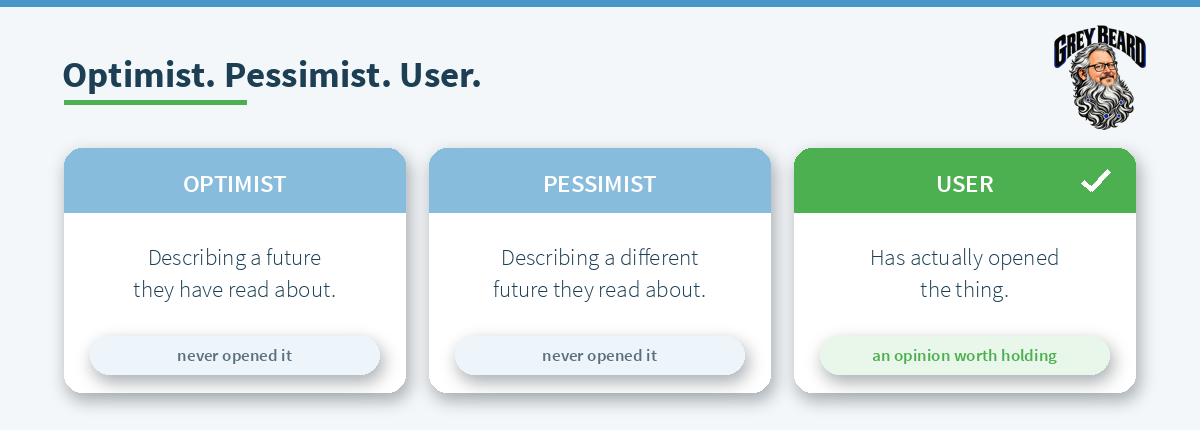
It’s a fair question, and I’ve come to dislike it, because both of the available answers are spectator answers. The optimist is describing a future they have read about. The pessimist is describing a different future they have read about. Neither position requires you to have opened the thing.
I know this because I held one of those positions myself, and I did not get out of it by being argued with.
It helps to name the three options honestly.
What actually changed my mind
What changed it was being trained in how to approach AI as a tool. Properly, by somebody who knew what they were doing.
That sounds like a small thing. It wasn’t, and I’ve thought a good deal since about why it was necessary at all. Nobody ever had to train me to use a search engine.
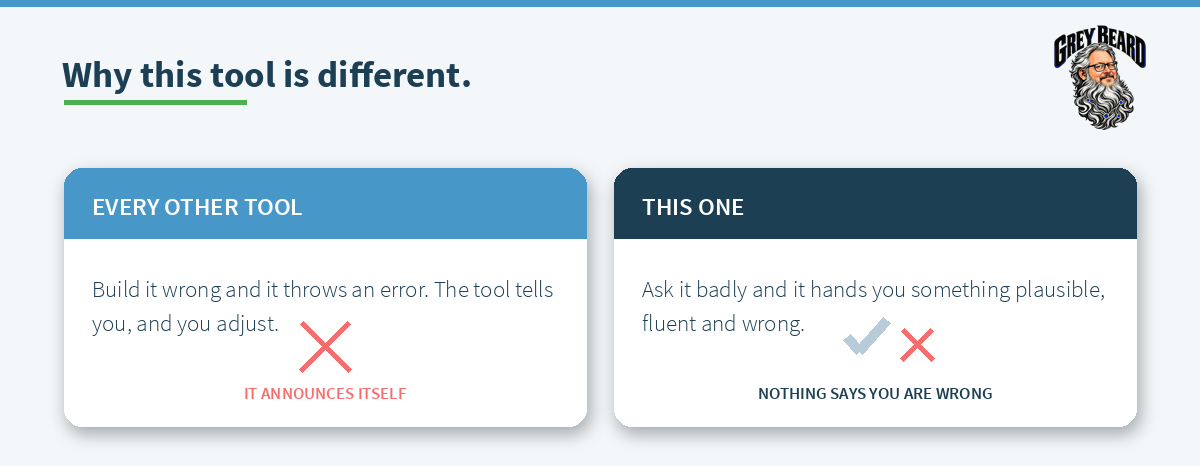
Here is the answer I’ve arrived at. With almost every other tool, incompetence announces itself. Build the model wrong and it throws an error. Mis-wire the report and the number comes out obviously absurd. The tool tells you that you are using it badly, and you adjust. This one does not. Ask it badly and it hands you something plausible, fluent and mediocre, and nothing in the experience suggests that the problem was you. So you conclude the technology is overhyped, and from where you are standing you are not even being unreasonable. You are simply the only person in the room who cannot see what went missing.
Here is the difference, in one picture.
That’s a trap you can sit in indefinitely. Most people do. I did, for the better part of a year.
What the training actually was
What the training gave me was not clever prompts. It was the shape of the instrument. What to put in front of it, and how much. How to break a problem into pieces it can actually hold at once. How to build the check into the task rather than bolting verification on at the end. What its failure modes look like, by name, so that I could see one arriving rather than discovering it later in front of a customer. And, more useful than any of that, when to stop, because a thread is going nowhere and persisting is costing me more than doing the thing myself would have.
The other half of it was simply watching somebody competent work. You cannot get that from documentation. Most of what I learned came from seeing how somebody further along handled their second attempt at a problem: the adjustment they made once the first answer came back wrong. Nobody writes that down, because it does not feel like knowledge. It is very nearly the whole of the skill.
My opinion changed about two weeks after that, and it changed because the thing in my hands had stopped matching the thing in my head.
Nobody has been talked out of a position on AI. They have been used out of one.
On the risk everyone wants to talk about
So where do I actually land?
Roughly here. I am no more worried about AI than I am about the general security questions that come with the internet.
I want to be careful with that, because it can read as complacency and it is not meant to. The internet is a serious risk surface. People lose their companies to it. We spend real money on it. We have controls and insurance and an entire profession devoted to it, and nobody proposes that we should therefore not have the internet. The risk is real, it is managed, and, most importantly, it is boring.
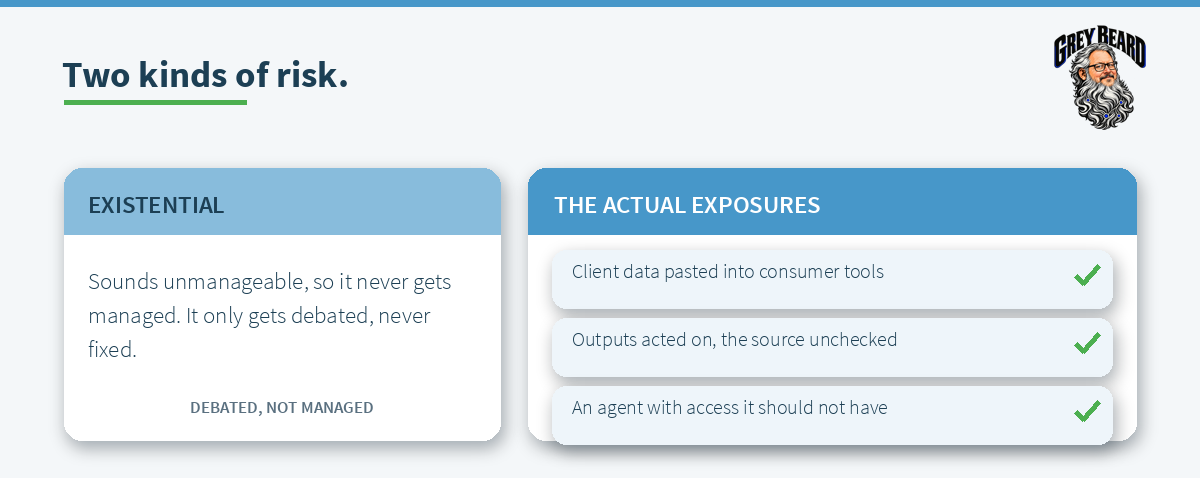
That is the category I think AI belongs in. The trouble with the existential framing isn’t that it is impolite. It is that it makes the risk sound unmanageable, and a risk that sounds unmanageable does not get managed. It gets debated.
Meanwhile the actual exposures sit there untouched. Staff pasting client data into consumer tools because nobody ever told them which tool to trust. Outputs acted on without anyone checking the source. An agent granted access to a system it has no business touching, because the access model was designed on the assumption that every actor in it would be a person. Those are the risks in front of us. They are all tractable. And not one of them is interesting enough to write a book about.
Put the two kinds of risk side by side.
On the part that can actually do damage
And yes, it can do real damage. So can everything.
The objection I do take seriously is that AI is different because it can act, autonomously, and at scale. That is true, and it is the reason I have become so tedious on the subject of governance. But autonomy inside an enterprise is granted, not seized. Which agents are authorized to act, on which data, under which guardrails, with what audit trail behind them: those are decisions. They are made by people, in rooms, usually rooms with a finance person in them.
This is also where the unglamorous work pays for itself. An agent is only as trustworthy as the data under it and the record of how it reached an answer. Knowing which number is authoritative, which hierarchy is the real one, what your access actually entitles you to touch: that is the layer where leadership manages the business through EPM, Data & AI, and it is what turns an autonomous actor from a liability into something you can sign off on.
That is not a comfort, exactly. It is a responsibility. The constraint on this technology has always been what people decide to permit, and I expect it to stay that way for considerably longer than the current discourse assumes.
What business AI adoption keeps getting wrong
Which brings me to the thing I actually wanted to write about.
If opinions only change through use, and if use is the only thing that produces real judgment about what this technology is for, then there is an uncomfortable implication for every organization currently standing up an AI program.
Business AI is not going to get much better until people start using it in their personal lives.
I do not think that is a soft point. I think it is close to a law, and the history of every general-purpose technology we have adopted supports it.
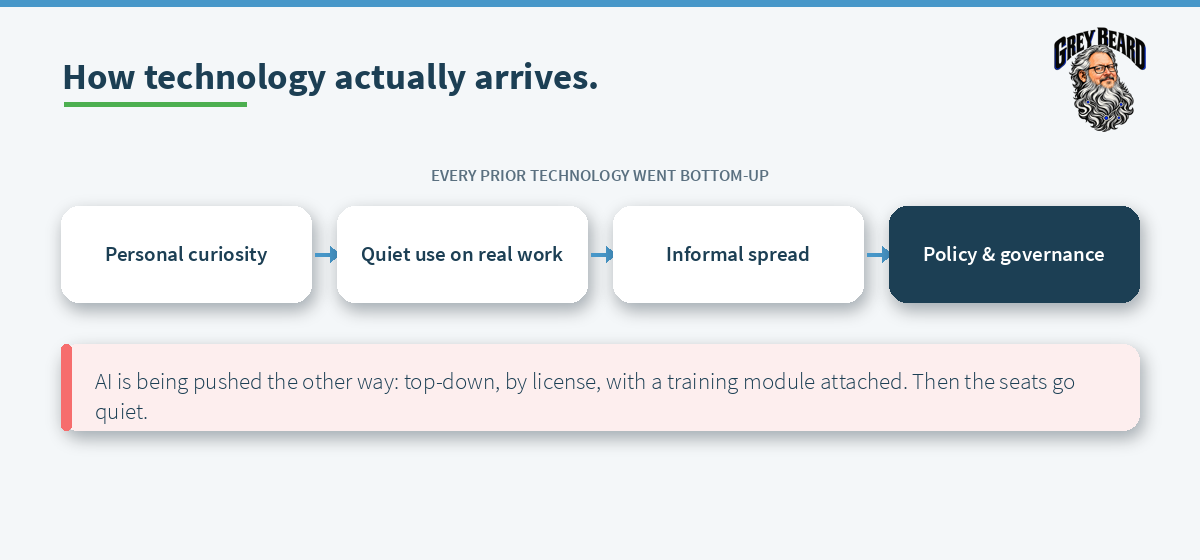
The spreadsheet did not arrive by procurement. Neither did the personal computer. The smartphone arrived in people’s pockets, and the enterprise spent five years catching up and then invented an acronym for its surrender. Cloud storage got in because people were already using it at home and would not stop. In every case the sequence was the same. Personal curiosity, then quiet use on real work, then informal spread, and only then the policy, the licenses and the governance.
AI is the first general-purpose technology in a generation that organizations have tried to introduce in the opposite direction. Top-down, by license, with a training module attached. And then we are all puzzled when the seats go quiet after two weeks.
We have seen this sequence before.
Why your own life is the only honest test
The reason personal use matters so much is not enthusiasm. It is that your own life is the only environment where you can learn the boundaries honestly. At home you are the entire decision-making committee. You can ask it something stupid at eleven at night. Hand it a problem where you already know the answer, which is the single most valuable thing anyone can do with one of these systems, and find out precisely where it starts inventing. You can use it on something you actually care about, and therefore bother to check.
The examples are unglamorous, and that is the point. Working out what is actually wrong with a contract before paying somebody to tell you. Planning something complicated with six constraints and two people who disagree. Learning a subject properly by making it explain the same idea four different ways until one of them lands. Getting a second opinion on a letter you were about to send while annoyed.
None of those are business use cases. Every one of them teaches you the instrument.
You cannot learn any of that from a sanctioned use case in a training environment. What you learn there is the sanctioned use case.
What it actually did to my working week
I have been describing all this as though it were a matter of opinion. It was not only that. The training, followed by months of using it on my own time, has done more for my working week than any tool I have adopted in my career. I want to be specific about where, because vague productivity claims are how this subject gets discredited.
Where the working week got easier
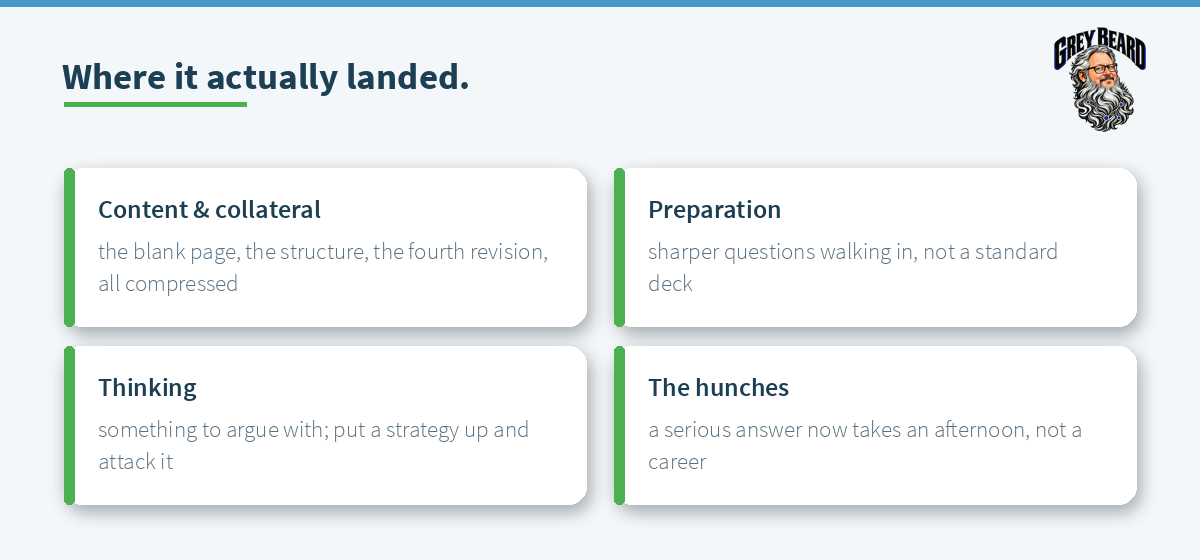
Content and collateral. Call it double. Not because it writes for me, since most of what comes back the first time is not good enough to put in front of a customer, but because the expensive part of a deck or a paper was never the writing. It was the blank page, the structure, and the fourth revision. All three of those compressed.
Preparation. I now walk into customer conversations having checked things I would previously have simply asserted. Before a discovery session I can interrogate what I actually know about how a given industry closes its books, have my own assumptions argued with, and turn up with sharper questions instead of a standard deck.
Thinking. The hardest of these to measure and by some distance the most valuable. I use it as something to argue with. I put a strategy in front of it and ask it to attack it. More than one of the directions we are now pursuing began in a session like that, not because it knew something I did not, but because it made me think faster, and more honestly, than I manage on my own.
The hunches. The ones I could never previously afford to check. Years of accumulated suspicion about why certain close processes fail the way they do, and until recently no realistic way to test any of it. A serious answer now takes an afternoon.
Concretely, it landed in four places.
And one effect I did not anticipate at all. It has made me better at the parts of the job it never touches. Framing a question precisely enough for a model to be useful turns out to be very nearly the same skill as framing it precisely enough for a person.
None of that came from the license. The license was the least consequential thing that happened to me. It came from being taught, and then from months of unsupervised use on things that mattered to nobody but me.
So, optimist or pessimist?
Neither. And I would gently suggest the question is a way of avoiding a more useful one.
The useful one is whether you have used it on something that mattered to you. Not at work, where the stakes are diffuse and somebody else chose the tool. On something of your own. A decision you have been putting off, a subject you wanted to understand properly, an argument you wanted tested, some piece of your own life that is more administratively tedious than it needs to be.
Do that for a month and you will have an opinion worth holding. It may well not be mine. But it will be yours, it will be based on contact with the actual object, and you will be considerably more use to your organization than anybody currently winning the argument on either side.
The business case follows the personal fluency. It always has.