
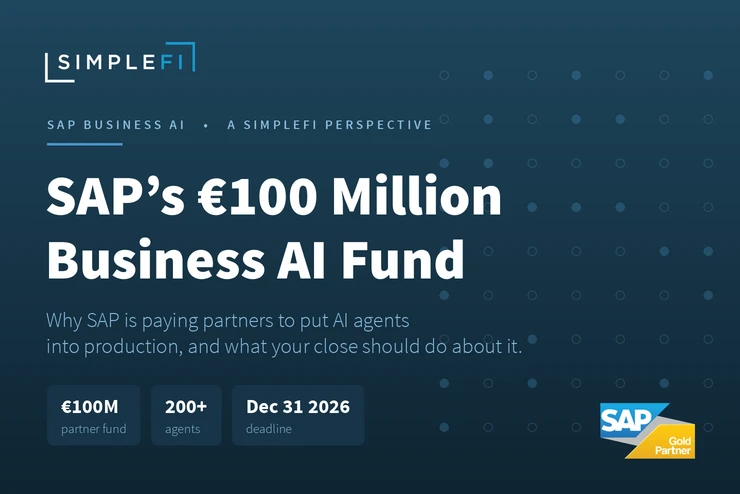
At Sapphire 2026, SAP put €100 million behind a bet about where AI belongs. Here is what the SAP Business AI adoption incentive means for your close, your forecast, and your 2026 roadmap.
The most important thing SAP did at Sapphire 2026 was a decision about shape.
Almost every other enterprise vendor has spent two years selling the same picture: one assistant, sitting above the business, that you ask things. A single pane of glass with a text box in it. It demos beautifully. It also sits outside the actual work, which is why so many of those deployments stall somewhere between “impressive” and “indispensable.”
SAP took the agent into the process
SAP went the other way. Instead of building one overarching AI and hoping the enterprise would come to it, SAP took the agent down into the process. The Autonomous Suite spans five domains: Finance, Spend, Supply Chain, HCM, and CX. It runs more than 200 specialized agents and over 50 Joule Assistants, each mapped to a real business role. The Autonomous Close Assistant does not advise you on the close. It posts journal entries, reconciles, and resolves errors, inside the close, with an audit trail. Sense, reason, act. Not suggest, wait, approve.
I wrote after Sapphire that this shift is more consequential than it sounds. It moves control from who approves what to which agents are authorized to act, on which data, and under which guardrails. So it is an operating-model change, not a technology purchase.
But there is a problem buried inside that strategy, and SAP clearly knows it. If your bet is that AI belongs in the process rather than above it, then you need an agent for every process that matters. And no vendor on earth, not SAP, not anyone, ships an agent for every process that matters at every customer. The 200 agents are the ones common enough to productize. The ones that would actually change your month-end, your rebate accruals, your intercompany reconciliation, your specific supplier scoring model? Those do not exist yet, because they are yours.
That gap is exactly what the €100 million is for.
The SAP Business AI adoption incentive is the strategy, expressed as money
At the Sapphire Partner Summit, SAP COO Sebastian Steinhaeuser pledged €100 million to the partner ecosystem to “fast forward AI adoption.” The vehicle is the SAP Business AI Partner-Led Adoption Incentive, and it is structured in four tiers that scale with ambition. It runs through the end of 2026, and it is open to commercial customers in the Enterprise and Corporate segments. Public sector is excluded.
Two details that matter more than the numbers
The first is what triggers payment. Historically, ecosystem money in enterprise software has funded marketing: campaigns, events, demand generation, pipeline theater. This fund pays on production deployment. Not on a workshop, not on a proof of concept, not on a slide that says “AI roadmap.” An agent has to be live in your environment, doing work, before anyone gets paid. SAP has effectively priced the outcome it wants and refused to pay for anything short of it.
The second is who it is aimed at. The money goes to partners, not to customers, but read that as a signal rather than a technicality. SAP is paying to have agents built that SAP itself is not going to build. Combine it with the rest of the Sapphire announcements and the intent is unmistakable. Joule Studio is now zero-infrastructure and free at design time through the end of 2026. Every agent built in it inherits native grounding in the SAP Knowledge Graph, Domain Models, and Business Data Cloud. And the partner agent race ahead of Sapphire drew more than 680 submissions. Free tooling, funded delivery, and the same context layer SAP’s own agents reason over. That is not a vendor protecting a walled garden. That is a vendor trying to get the garden planted faster than it can plant it alone.
Which tells you what SAP is actually worried about. Christian Klein has been candid that adoption is early, with roughly three-quarters of customers still sitting in the experimental phase. The Autonomous Enterprise vision does not fail because the technology is not ready. It fails if customers spend 2026 running pilots and 2027 explaining why the pilots did not scale.
€100 million is SAP buying its way past the pilot wall.
What a CFO or CIO should take from this
The economics of your first agent just changed, and that is the smaller point. Yes, the funded engagement means the build is largely covered rather than competing against every other line in your budget. But cheap is not the reason to do this. The reason is that the window where SAP is actively paying to have process-specific agents built is finite. The customers who use it will enter 2027 with agents in production, while their peers are still writing a business case. That is the real design of the SAP Business AI adoption incentive.
Pick processes, not products
The €50K and €100K tiers reward agents plus orchestrated workflows, because an agent that does not sit inside a workflow is a demo. Choose two or three processes where you can name the metric that moves: days to close, forecast cycle time, variance investigation effort, supplier risk detection. If you cannot name the metric, you are not ready to nominate that use case.
The foundation still decides the outcome
Klein said it plainly: no AI agent can compensate for a broken data model. Two-thirds of the enterprise AI failures we see trace back to data, not models. Funding covers the agent. It does not cover ungoverned master data, and it does not cover change management. Plugging agents into your landscape drives zero value on its own.
The deadline is real
The program runs to December 31, 2026, evaluated first come and strongest project. That is a genuinely awkward date, because the scoping conversation needs to happen well before the calendar suggests it does.
The through-line
In short, SAP’s whole thesis is that AI earns its keep by living inside the process, not hovering above it. The SAP Business AI adoption incentive is that thesis with a price tag attached: SAP acknowledging that embedded AI at enterprise scale is a job too big to do alone, and paying to close the distance.
For a CFO or CIO, the question this year is no longer whether agentic AI is credible in SAP. It is which two or three of your processes are worth putting an agent inside first, and whether you would rather find out in 2027, at full cost.
If you want to think through where that starts in your environment, that is a conversation we are having with a lot of customers right now. It usually begins with a much simpler question: what is actually slowing your close down?