
Every project I delivered left nine good questions in a drawer. For the first time in my career, the drawer is cheap to open.
By Grey Beard
- Every discovery surfaces about twelve real questions. We only ever had budget to chase three. The other nine got filed in a drawer.
- The limit was never intelligence. It was the price of a question: two weeks of work to check a single hunch, so most hunches went unchecked.
- AI has cut that price to almost nothing. That makes judgment, and trusted data, the thing that matters most, which is why data governance for AI is now the real work.
Perhaps it’s the grey in my beard, or the fact that I just put my back out from sneezing, but I am spending more time these days in retrospect. There is an advertisement going around at the moment. It says that everyone is trying to get better at AI, but the people who will win the next decade are getting better at being human.
I have been in enterprise finance long enough to be suspicious of a line that good. It is the sort of thing that sounds profound while asking nothing of you. It caught me anyway, because it named something I had been circling for months, though the version I have arrived at is not quite the one on the advertisement.
Mine is this. The interesting thing about AI is that it can change how we work, but it also changes what we are able to ask, often more questions. And that turns out to be a genuinely unsettling proposition for somebody who has spent a career building and adjusting processes most people didn’t have time to ask many questions about.
Most of my projects were a success
I want to be precise about this, because it is the uncomfortable part.
Over the years I have been involved in a great many implementations, redesigns, migrations and rescues. Planning systems. Consolidation systems. Close processes. Reporting systems that had grown into big, long, wavy stringing things.
Most of them succeeded. The scope was delivered, we trained the users, the thing went live, the sponsor signed it off, and in most cases the organization was measurably better off afterward than it had been before.
Success, as defined.
That phrase has started to sound different to me than it used to.
Twelve threads, and you get to pull three
Anyone who has led one knows the shape of it. You spend a few weeks inside a business and the business tells you things, not always on purpose. By the end you have a list.
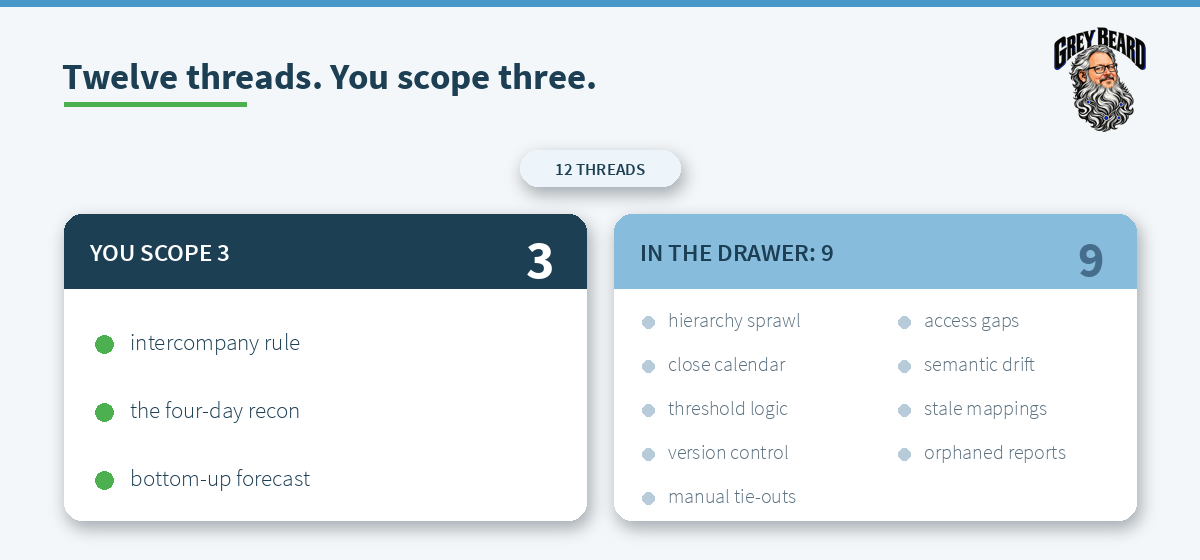
The list is never three items long. The list is twelve. Twelve threads, each one a real question about how this organization operates. Why the intercompany matching rule is written the way it is. How three functions came to maintain three versions of the same hierarchy. Why we build the forecast bottom-up when nobody believes the bottom. And why that one reconciliation takes four days, and has taken four days since before anybody currently in the room was employed here.
And then you scope.
You take the twelve, and you pick three.
Not the three most interesting. The three most tractable: the ones you can defend to a steering committee, size with some confidence, and finish inside the window. The other nine go into a document. Everybody in the room understands what that document is. It is a decent burial.
In practice it looks like this.
I want to be clear that this was not negligence, and that the people doing it, me very much included, were not lazy. It was arithmetic.
The constraint was never intelligence. It was the price of a question.
To know whether thread number seven was worth pursuing, somebody had to go and find out. Pull the data. Clean it. Build something to test the hypothesis against. Look at the result, decide whether it meant anything, and write it up well enough that a person with budget authority would act on it.
Two weeks. Call it two weeks for a serious answer to a serious question. Times nine.
The arithmetic was never subtle.
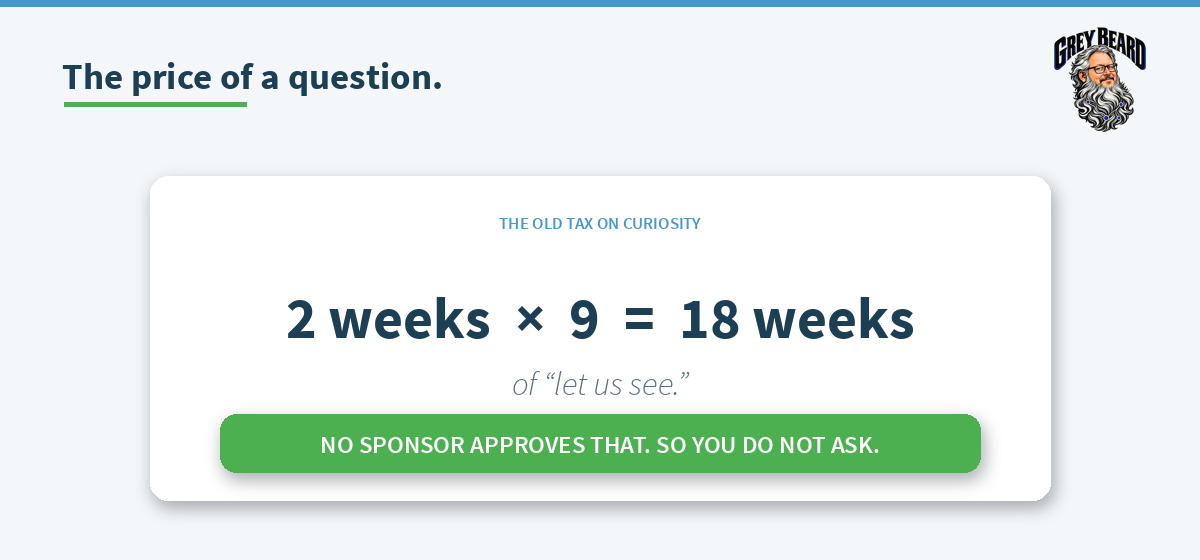
No sponsor on earth approves eighteen weeks of “let us see.” So you do not ask. You pick your three, you deliver, and the nine threads remain exactly as unexamined as they were the day you walked in, except that now there is a successful project sitting on top of them, which makes them harder to see.
That was the governing constraint of my entire working life, and I did not recognize it as a constraint. I thought it was simply what the job was.
What finally changed my mind, and it was not a tool
I spent the early part of my own AI education doing the obvious thing, which was trying to build with it. Many times, trying to “code” the AI. Treating it as an engineering problem. Automate the task, wire up the integration, make the thing go. Some of that worked. Most of it was slower than advertised, and all of it kept me down at the level of individual tasks, which is the level where AI is genuinely useful and completely unremarkable.
The shift happened because of training. I had the fortunate opportunity to be schooled in not just the AI tools available but also how to approach the challenge. I stopped asking it to build things and started asking it to think alongside me. Putting a half-formed idea in front of it and getting back three framings I had not considered. Testing an argument before taking it to anybody. Chasing a hunch at eleven at night, because chasing it cost me forty minutes instead of several days.
And somewhere in there I worked out what I was actually doing.
I was pulling strands.
For the first time in my career I was in a position to follow the ninth thread. Not to deliver it, just to check it. To establish in an afternoon whether the thing I had suspected about how a certain kind of close process fails was actually true, or whether I had been carrying around a folk belief.
I did not expect to find that exhilarating at my age. I did.
The fossils in the floor
Once you start looking at it this way you cannot stop, and where it is most visible is in finance.
Almost every convention in a finance function is a solved problem wearing the clothes of a principle. The shape of the close calendar is an answer to a question about batch processing time. Thresholds sit where they sit because investigating a variance used to cost a week of a qualified person’s attention, so the bar went where the investigations would stay affordable.
We reforecast quarterly because gathering the inputs took six weeks, and you cannot repeat a six-week exercise every month. We flattened hierarchies because the system could not carry the depth.
A few of them, to be specific.
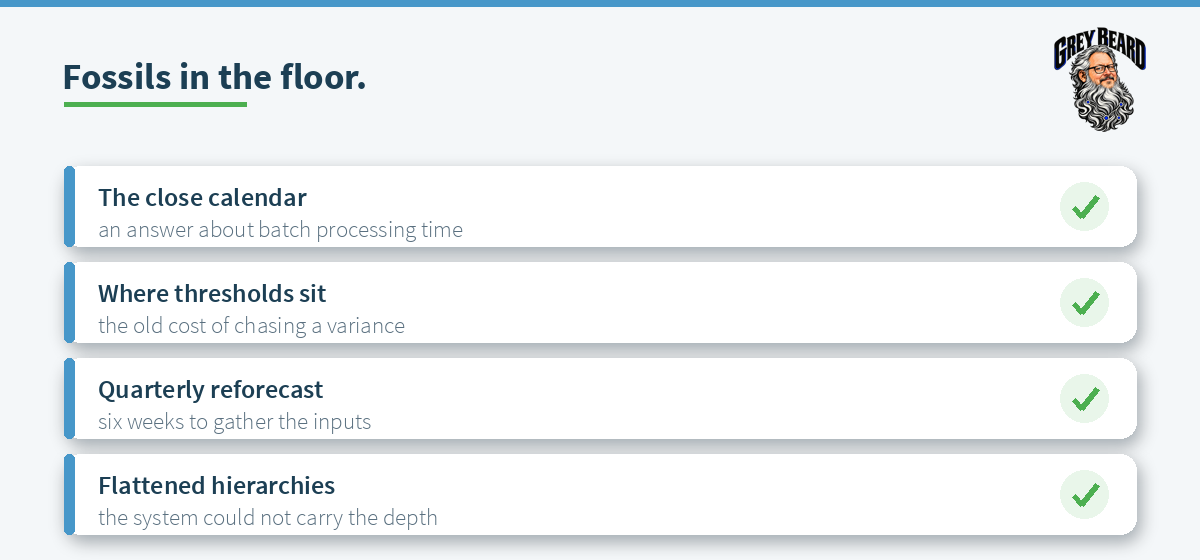
Every one of those was the right answer. I would have given the same answer. The difficulty is that nobody has re-asked the questions, and the constraints that produced the answers have quietly expired.
This is what I think people ought to mean when they talk about AI transforming finance. Not that an agent will push the buttons faster. That the reason the buttons exist is now worth re-examining, and that for the first time, re-examining it is cheap enough to actually do.
So what is left for the humans?
Here is where I part company slightly with the advertisement.
If the cost of investigating a question falls by an order of magnitude, the scarce resource is no longer the investigation. It is knowing which hypothesis deserves one. Twelve threads is not the ceiling anymore. But somebody still has to walk into a business and see twelve threads rather than two, and know which of them is load-bearing.
Which leaves one thing that is genuinely scarce.
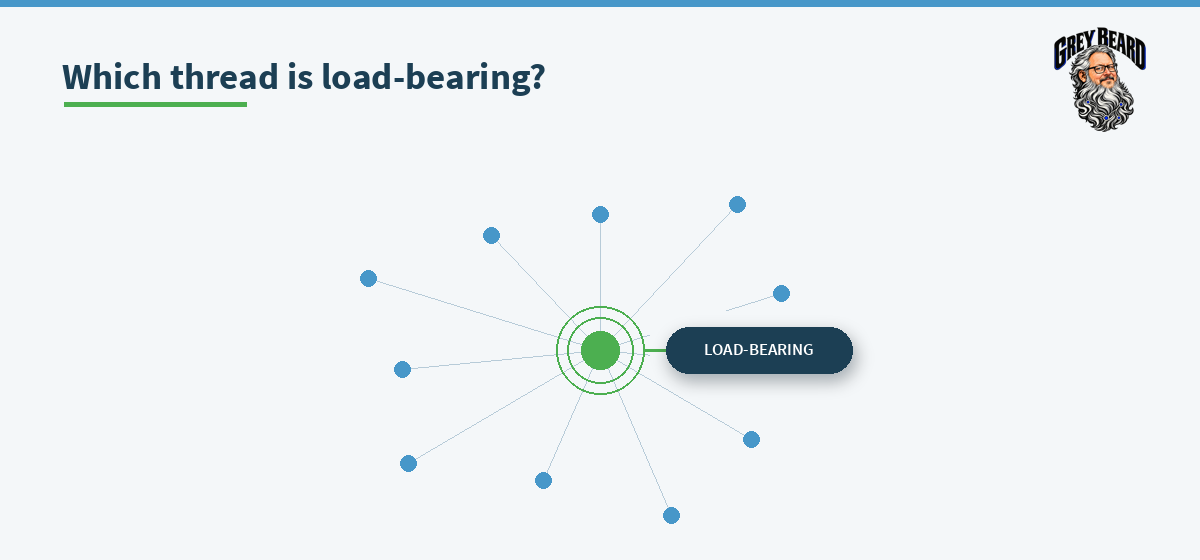
That is not a skill you acquire from a tool. It comes from having been there when it broke. From having implemented the thing that seemed perfectly sensible and watched it fail in a way nobody predicted. From a sort of accumulated suspicion about where organizations hide their problems.
Which is to say: the bottleneck that prevented it from being applied has gone.
It is precisely what a long career gives you, and it has just become dramatically more valuable.
I find that genuinely encouraging, and I would not have predicted it two years ago. The expectation was that this technology would make long experience cheap. What it has actually done, in my case, is make it usable, because the limiting factor was never a shortage of hunches. It was that I could not afford to check them.
The catch, and it is a serious one
None of this works if you cannot trust the ground.
A world in which questions are cheap is also a world in which plausible answers are cheap, and those are not the same thing. If I can investigate twelve strands in the time it used to take to investigate one, I can also generate twelve confident, well-written, internally consistent accounts of something that is not true. The speed is only an asset if what sits underneath it is solid.
This is why I have become tiresome on the subject of data governance and the importance of being AI educated. It is not a compliance exercise. It is the thing that determines whether your cheap questions produce knowledge or produce fiction. Knowing where the authoritative version of a number lives, what your access actually entitles you to see, which hierarchy is the real one, what the semantic layer means by “revenue”: that is not bureaucracy. That is the difference between following a strand and inventing one.
And it is why keeping a clear record of how each answer was reached matters more as the pace increases, not less. If you are going to pursue ten times as many lines of inquiry, you need to be able to show how each conclusion was arrived at. Otherwise, in twelve months, you have a hundred conclusions and no idea which of them to believe.
Which is why I keep coming back to the data
I will keep this part short, because it is the least interesting section of the essay to anybody who does not spend their days in finance systems.
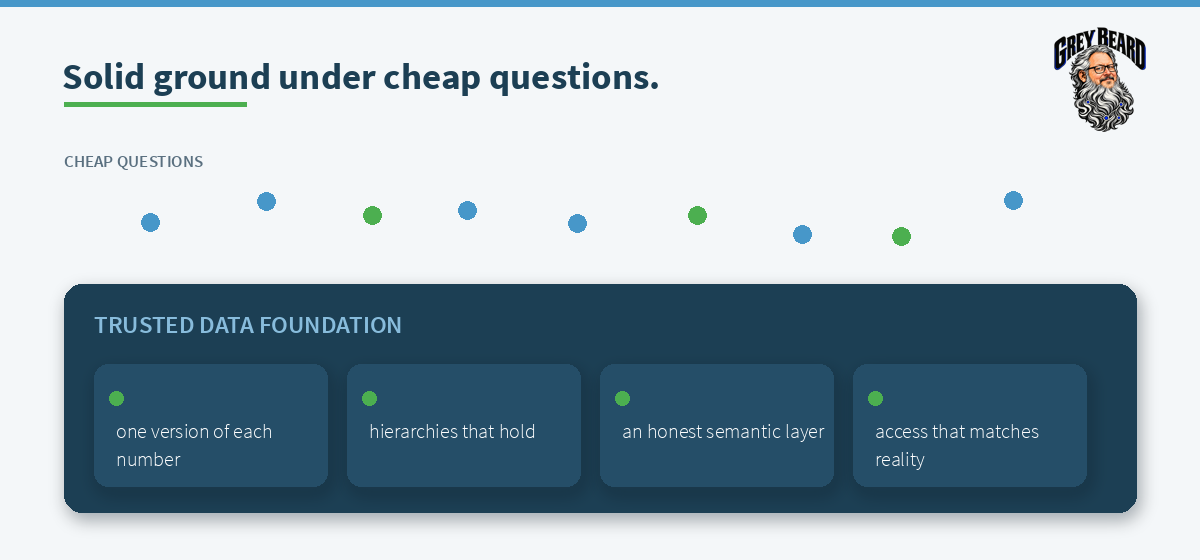
None of what I have described survives contact with bad data. You cannot hand somebody a license and a clever model and expect good questions to come back with good answers. The instinct to pull strands is only worth having if the ground under each strand is solid: the same unglamorous things I just described, a number you can trust, hierarchies that hold, a semantic layer that means what it says.
That is unglamorous work, and it is the work I spend my time on. Get the trusted data foundation right first, in the layer where leadership actually manages the business through EPM, Data & AI, and the cheap questions start producing knowledge instead of fiction. Skip it, and you have simply made it cheaper to be confidently wrong.
It scales down to a handful of executives and up through the business, function by function. That is a logistics question rather than a philosophical one, and I am happy to bore anybody about it separately.
And none of it survives without the unglamorous part.
If you are still delivering phase one, read this
I have spent most of a career delivering projects that succeeded, as defined, while quietly accepting that the definition was set by what we could afford to find out.
That constraint has moved. It has not disappeared. Judgment is still expensive, trust is still expensive, and being wrong is still expensive. But the specific, unglamorous, decades-long tax on curiosity, the one that made nine out of every twelve good questions unaffordable, has come down enormously. Almost nobody in finance has adjusted their behavior to account for it yet.
Everyone is busy getting better at the tools. That is fine. The tools are not the hard part.
The opportunity is sitting in the drawer where we filed the other nine.